
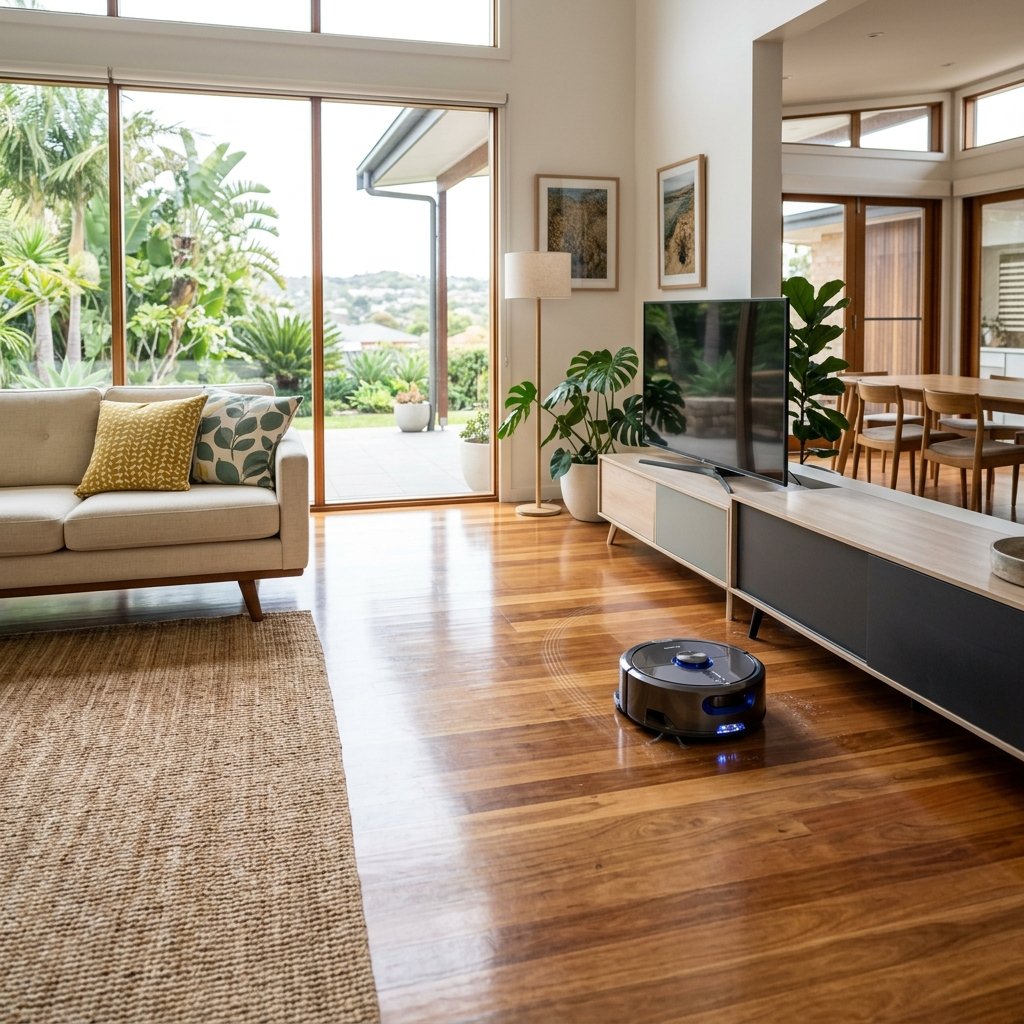
Robot vacuums have gone from novelty to mainstream, but they haven’t made traditional vacuums obsolete. Understanding what each format does well — and where it falls short — helps you decide whether you need one, the other, or both.
Quick Answer
Robot vacuums excel at frequent, low-effort maintenance cleaning on hard floors and low-pile carpet, while traditional vacuums (corded or cordless) remain better for deep cleaning thick carpet, stairs, upholstery and edges. Many Australian households now use both: a robot for daily upkeep and a traditional vacuum for weekly deep cleans.
What Robot Vacuums Do Well
Robot vacuums clean autonomously on a schedule, which is genuinely useful for busy households or anyone with mobility limitations. Modern models use LiDAR or camera-based mapping to navigate efficiently and avoid obstacles, and many now include self-emptying docks that reduce hands-on maintenance to roughly once a month. They perform best on hard floors, tile and low-pile carpet.
Where Robot Vacuums Fall Short
Robot vacuums generally can’t climb stairs, struggle with thick or high-pile carpet, and can get stuck on cords, rugs edges or pet toys. Their smaller dust bins and less powerful motors mean they’re not a substitute for a deep clean, particularly in homes with pets or allergy sufferers who need stronger, more targeted suction periodically.
What Traditional Vacuums Do Well
Corded and cordless stick or upright vacuums offer stronger, more consistent suction, better carpet agitation through motorised brush heads, and the flexibility to clean stairs, upholstery and tight corners with attachments. For allergy-affected households, a traditional vacuum with sealed HEPA filtration and strong suction is still the more thorough option.
Comparison Table
| Factor | Robot Vacuum | Traditional Vacuum |
|---|---|---|
| Best for | Daily maintenance, hard floors | Deep cleaning, all floor types |
| Stairs | Cannot climb | Fully capable |
| Suction power | Lower | Higher |
| Effort required | Minimal (autonomous) | Active, hands-on |
| Typical price (AUD) | $300–$1,800 | $150–$1,200 |
| Bin capacity | Small (0.3–0.5L) | Larger (0.5–3L) |
Which Should You Choose?
If your home is mostly hard flooring with minimal stairs and you want low-effort daily upkeep, a robot vacuum alone may be sufficient. If you have thick carpet, stairs, pets or allergy concerns, a traditional vacuum should be your primary tool, with a robot vacuum as an optional convenience layer rather than a replacement.
Final Thoughts
Robot and traditional vacuums solve different problems rather than competing directly. Understanding this distinction helps you avoid over-relying on a robot vacuum for tasks it isn’t built for, or under-using one where it could genuinely save time.
Comparing specific robot models? See our Best Robot Vacuum Cleaners in Australia 2026 guide. Read Best Robot Vacuum Cleaners in Australia 2026 →
Key Takeaways
Robot vacuums suit daily, low-effort maintenance on hard floors and low-pile carpet.
Traditional vacuums remain necessary for deep cleaning, stairs, thick carpet and allergy control.
Many Australian households benefit from using both formats together.
Frequently Asked Questions
For homes with mostly hard floors and no stairs, largely yes. For homes with thick carpet, stairs or pets, a traditional vacuum is still needed for thorough cleaning.
They handle low-pile carpet reasonably well but struggle with thick or high-pile carpet compared to a traditional vacuum with a motorised brush head.
They help with daily maintenance but generally can’t match a traditional vacuum’s suction and brush agitation for embedded pet hair in carpet.
Daily is common for households relying on it as a maintenance layer, alongside a weekly deeper clean with a traditional vacuum.
No, robot vacuums cannot climb stairs and require separate cleaning for multi-level homes.
It depends on your priorities — a robot vacuum adds convenience for daily upkeep but isn’t essential if you’re happy maintaining a regular vacuuming schedule manually.
Traditional vacuums with sealed HEPA filtration generally offer stronger allergen removal, though a robot vacuum running daily can help reduce dust buildup between deep cleans.
Yes — regular bin emptying, brush cleaning and sensor wiping, though self-emptying docks reduce hands-on maintenance significantly.
They can get tangled in cords, rug tassels or pet toys, particularly older or budget models with less sophisticated navigation.
For many households, yes — using a robot for daily hard-floor maintenance and a traditional vacuum for weekly deep cleaning covers both convenience and thoroughness.
Really useful breakdown — this matched what I found testing a couple of models myself. Appreciate the Australian-specific detail.
Would love an update once the newer models land locally, but this gave me enough to make a confident decision.