
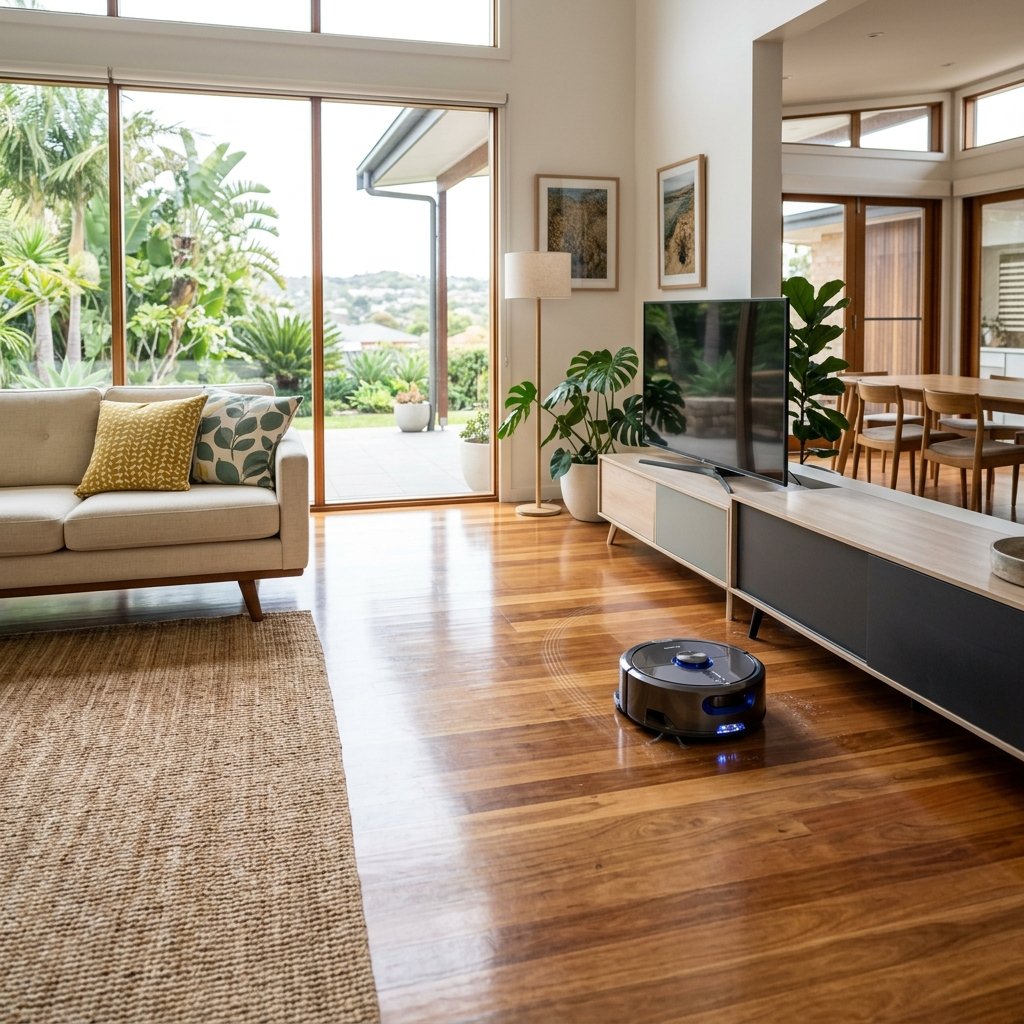
Robot vacuums vary enormously in navigation quality, suction and convenience features like self-emptying docks. Here’s how to find the right one for your home layout and budget.
Quick Answer
For most homes, a mid-range robot vacuum ($500–$900) with LiDAR navigation and a self-emptying dock offers the best balance of reliability and convenience. Budget models under $400 suit smaller, simpler layouts.
What Separates a Good Robot Vacuum From an Average One
Navigation technology matters most — LiDAR and camera-based mapping avoid obstacles and clean systematically, while budget bump-sensor models clean less efficiently and get stuck more often. Suction power, mopping capability, and self-emptying dock convenience are the next differentiators.
Best Premium Pick
Roborock and Ecovacs flagship models lead on navigation sophistication, combined mopping-and-vacuuming function, and self-emptying, self-washing docks, typically $900–$1,800.
Best Mid-Range Pick
Mid-tier Roborock, Ecovacs and Eufy models in the $500–$900 range offer strong LiDAR navigation and self-emptying docks without flagship pricing.
Best Budget Pick
Eufy and Kogan budget robot vacuums under $400 handle simple, obstacle-light layouts well, though navigation and suction are more limited.
Comparison Table
| Tier | Price (AUD) | Navigation | Best For |
|---|---|---|---|
| Premium | $900–$1,800 | LiDAR + mopping | Complex layouts, hands-off maintenance |
| Mid-range | $500–$900 | LiDAR | Most homes |
| Budget | Under $400 | Bump sensor / basic mapping | Small, simple layouts |
Final Thoughts
Match navigation sophistication and dock convenience to your home’s complexity and your tolerance for hands-on maintenance, rather than choosing on price alone.
See our Robot Vacuum vs Traditional Vacuum guide to decide if a robot vacuum should be your primary or secondary cleaning tool.
Key Takeaways
LiDAR navigation and self-emptying docks are the key upgrades worth paying for.
$500–$900 is the sweet spot for most homes.
Budget models suit simple, obstacle-light layouts best.
Frequently Asked Questions
Mid-to-premium models with strong suction and larger dustbins or self-emptying docks handle pet hair better than budget options.
Yes, particularly on low-pile carpet; thick or high-pile carpet is better handled by a traditional vacuum.
For busy households, yes — it reduces hands-on maintenance to roughly once a month instead of after every clean.
Premium models use LiDAR laser mapping or camera-based vision; budget models often rely on simpler bump-sensor navigation.
Many mid-to-premium models now combine both functions, though mopping is generally lighter-duty than a dedicated mop.
After every clean for standard models; self-emptying dock models can go several weeks between manual emptying.
Yes, particularly LiDAR-equipped models that can map and remember multiple rooms and floors.
Typically four to six years, depending on battery health and how well it’s maintained.
Really useful breakdown — this matched what I found testing a couple of models myself. Appreciate the Australian-specific detail.
Would love an update once the newer models land locally, but this gave me enough to make a confident decision.